
The gasworks at Beckton in the borough of Newham played a significant role in the East End industry for over 100 years. Its story also illustrates how this once thriving industrial area has declined and changed its focus. Formerly the largest gasworks in Europe, Beckton Gasworks was in use from 1870 to 1969, when it closed down.
Beckton Gas Works Legacy
The site buildings and structure no longer exist, but the gasworks has left some legacy in the area in the form of the Beckton Alps.
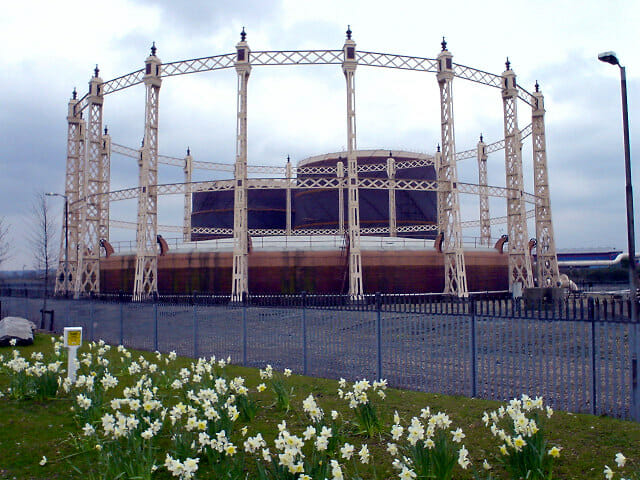
The History of London’s Famous Gas Works
The East End was a hive of industry in the late 1800s. Its proximity to the Thames’s docklands and its position outside central London made this an ideal location for various dangerous manufacturing and production industries.
In 1870, the Gas Light and Coke Company, under the leadership of Simon Adams Beck, decided to open a gasworks in the area. The site and the surrounding area got the Beckton name from Simon Adams Beck. Although there was plenty of competition in the area, the Beckton Gas Works eventually became the foremost manufacturer of gas for London, at least north of the Thames.
The Victorians had discovered a way to produce gas from coal, which was Beckton’s main activity. Many industries also use this process’s by-products to manufacture other products such as coal tar, dyes, disinfectants, ammonia and sulphuric acid.

However, the Gas Light and Coke Company decided pretty early on that it would be more profitable to use their by-products rather than sell them to other manufacturers. In 1879, the company set up the Beckton Products Works, becoming the UK’s largest manufacturer of tar and ammonia by-products.
The site of the gasworks was huge, covering over 500 acres. It had its own piers on the Thames and could simultaneously store a quarter of a million tons of coal. The company brought coal into the plant for manufacture and had a thriving business selling the by-products of gas production that it did not use. At one point, the gasworks ran 17 collier ships and an extensive internal railway on site. At its peak, the gasworks is thought to have employed 10,000 men.

Ben Brooksbank, CC BY-SA 2.0
creativecommons.org
via Wikimedia Commons
In the late 1940s, nationalisation saw the gasworks pass into the hands of the North Thames Gas Board. Over time, natural gas reserves in the North Sea made many gasworks like Beckton relatively redundant, and the plant was closed down in 1969, as it could not compete with natural gas prices. British Gas and Transco ultimately managed the site after it had closed down and was left in a derelict state for many years.
The Beckton Alps
Producing gas from coal left the company with large amounts of toxic waste, which could not be used for any other purpose, and it all ended up being piled up on the site, creating an artificial range of hills. Locals started to call this the Beckton Alps, and the name stuck.
Although the hill was landscaped and made much smaller, it was still big enough to run as a dry ski slope for a while. This is now the highest point in the area and is designated as a site of importance for nature conservation. It is now the only remaining evidence that the Beckton Gas Works stood on this spot.

The Beckton Gas Works in Films
The derelict state of the site made it an ideal location for filming, and Beckton Gas Works has appeared in a surprising number of Hollywood movies. It is perhaps best known as becoming Vietnam in the Stanley Kubrick film “Full Metal Jacket”. Its derelict state was perfect for a war-ravaged landscape, although it has to be said that Kubrick’s dynamiting of areas within the site left it in a far worst shape than when he started!

CreativeCommons
The gasworks also appeared in the opening sequence of the James Bond movie, “For Your Eyes Only”, and was used for London scenes in Nineteen Eighty-Four. Oddly, the location was also used in the John Wayne film, “Brannigan”.
Beckton Gas Works in the present
The buildings of Beckton Gas Works no longer exist. As with many areas of the East End, it took many years to deal with the fall-out as industries moved away from the area and to manage regeneration after the Second World War. Beckton has seen a lot of redevelopment in the last few years as part of the Docklands project, although much of this development in the area is in private housing. The original site is now mainly home to retail and shopping parks.
In Summary
Beckton Gas Works was a primary gas production and storage facility in the East London borough of Newham. The site was established in the 1870s and remained in operation until the 1970s, playing a significant role in the development of the gas industry in the UK.
At its peak, Beckton Gas Works was one of Europe’s most significant gas works, covering an area of over 500 acres and producing around 5 million cubic meters of gas per day. The site was situated on the banks of the River Thames, which provided a convenient source of coal and enabled gas to be transported to other parts of the city by barge.
The gas produced at Beckton was used for various purposes, including street lighting, heating, and cooking. In the early days, gas was produced by heating coal in large ovens called retorts, which had a range of by-products such as Coke, tar, and ammonia. The Coke fueled the retorts, while the tar and ammonia were sold to other industries.

Ordnance Survey Six-Inch England and Wales
1842-1952, CC BY-SA 4.0
https://creativecommons.org
via Wikimedia Commons
Over time, the gas production process was refined, and more efficient methods were developed. In the 1930s, Beckton became one of the first gas works in the UK to use the water-gas process, which involved passing steam over hot Coke to produce a gas rich in hydrogen. This process was more efficient than the traditional coal-gas process and enabled the production of gas to be increased significantly.
During World War II, Beckton Gas Works supplied gas to London during the blackout. The gas produced at Beckton was used for street lighting and to power vehicles such as buses and taxis. German bombers also targeted the site and attempted to disrupt gas production by damaging the retort houses and gasometers.
After the war, the demand for gas continued to increase, and Beckton underwent a series of modernisation programs to improve efficiency and increase capacity. However, by the 1960s, it was clear that the site was becoming obsolete, and plans were made to close it down.
Gas Works Closure
The closure of Beckton Gas Works was a significant event for the local community, as many people had worked there for generations. However, the closure also marked the beginning of a new era, as the site was redeveloped for new uses such as housing and retail.

Graham Smith from England, CC BY 2.0
creativecommons.org
via Wikimedia Commons
Today, the former site of Beckton Gas Works is known as Beckton District Park, a large public park that covers over 200 acres. The park features a range of facilities, including sports fields, playgrounds, and a nature reserve. The site also contains several historic buildings and structures, including the original gasometers, which have been preserved as a reminder of the site’s industrial heritage.
In conclusion, Beckton Gas Works was a significant part of the gas industry in the UK and played a vital role in supplying gas to London for over a century. Although the site is no longer in operation, its legacy lives on, and the redevelopment of the site has created new opportunities for the local community.